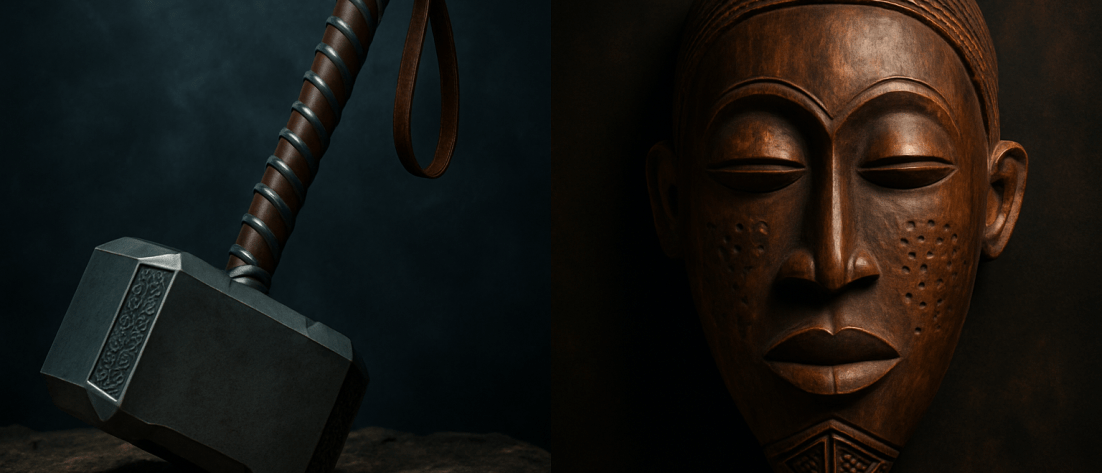
If you walked into a bookstore and picked up a fantasy novel about Zeus, Poseidon, or Medusa, you wouldn’t blink twice. You’d probably even be intrigued. But what if you saw a book about Sango or Ogun? Suddenly, it’s “demonic” or “dark.” And yet, weren’t they all once gods to someone?
Why?
Why are Africans, even those of strong faith, okay with honoring or entertaining foreign deities like Thor, Zeus, or Odin, yet shrink away from their own?
Across generations, we’ve been wired to fear what is African. To distrust our own mythology and even see it as boring. To abandon the stories our ancestors once whispered by firelight, while embracing the tales of foreign gods and folklore as noble, cool, or even educational.
This isn’t just about preference. It’s about a deeper history, one rooted in erasure, colonial influence, and the demonization of African identity.
And no, this isn’t a campaign for anyone to worship anything. It’s simply about perspective, questioning why one set of gods is seen as entertaining or noble, while the other is rejected without understanding.
It’s time we told the full story.
The Gods the World Still Worships
Many think Greek and Norse gods are relics of the past but they’re not. Hellenism and Ásatrú still thrive today. People still pray to Zeus in Greece. People still hold rituals for Thor in Iceland.
Likewise, in Africa and across the diaspora, traditional African spirituality still breathes.
– In Ghana, the Akan people revere Nyame, the sky father, and Asase Yaa, the goddess of fertility and earth.
– In Zimbabwe, ancestral spirits and figures like Mbuya Nehanda are honored, not just as history but as spiritual anchors.
– In Congo, Nzambi Mpungu remains the supreme god of the Bakongo people.
– In Benin, the Vodun religion still thrives, the spiritual root of Haitian Vodou, which honors Danbala, Ezili, Legba, and more.
– In Nigeria, it’s not just Sango and Ogun, the Ijaw people honor Egbesu, god of justice and war.
– Across Cameroon and parts of Central Africa, deities and nature spirits are still part of everyday life.
But despite this rich spread, there’s a strange contradiction: many Africans, especially in cities or in religious households, can watch fantasy about Greek or Norse gods, but immediately label African deities as evil.
Why is that?
Colonialism and the Demonization of African Spirituality
When Europeans arrived in Africa, they didn’t just bring trade and religion, they brought a cultural erasure machine.
Everything native was considered “primitive,” “demonic,” or “uncivilized.” Shrines were destroyed. Priests were shamed. Deities were demonized. The spiritual systems that sustained entire civilizations were rewritten as superstition.
Even today, in schools across Africa, students are taught about the gods of Olympus. But no one tells them about Nehanda, the spiritual warrior of Zimbabwe. No one tells them about Nzambi or the gods of the Fon, Shona, or Serer people.
Generations of Africans were raised to believe their spirituality was wrong while the gods of Greece were merely “mythology” to be studied without judgment.
That psychological conditioning still lingers.
Pop Culture: Where African Gods Are Excluded or Misrepresented
Think of how many movies you’ve seen with Zeus, Hades, or Thor.
Now think of how many you’ve seen with Nyame, Esu, Nehanda, or Nzambi.
Not many.
And when African spirituality does show up, it’s often shrouded in fear: dark rooms, flickering candles, drums beating ominously. We see this in:
– The Skeleton Key (2005) – Hoodoo presented through horror tropes.
– American Horror Story: Coven – Papa Legba, a central Vodou figure, depicted as grim and eerie.
– Even in The Princess and the Frog (Disney), the villain Dr. Facilier is linked to “dark” shadow magic inspired by Vodou, reinforcing the idea that African-rooted spirituality equals danger.
Rarely are these belief systems shown with beauty or nuance.
But there are exceptions.
A good representation is seen in the animation Castlevania: Nocturne. If you’ve watched it, you’ll remember Annette, a Haitian woman whose powers are drawn from her African roots, channeling ancestral strength through rituals and memory. She’s fierce, regal, and powerful.
Why can’t we have more of that?
We’re Not Asking You to Worship, Just to See the Bias
Let’s be clear: this is not an appeal to leave your faith. Most Africans are Christian or Muslim. This article doesn’t ask you to worship deities or believe in multiple gods.
But if we can read Norse mythology without becoming Norse pagan, or watch Marvel’s Thor without becoming believers in Valhalla, why can’t we talk about Sango, Esu, Nehanda, or Nzambi without guilt?
This is about breaking a pattern, a pattern that teaches us that anything African must be feared or erased.
You don’t need to believe in these gods to understand them or to learn their place in our history and culture.
Reclaiming Without Regret
African stories deserve to be told too, not just in whispers, not just in temples, but in books, on screens, in classrooms.
Our deities were explanations for thunder, rain, war, healing, death, birth, the big questions our ancestors tried to answer long before colonization told them they were wrong for trying.
When we learn about Athena, it’s called “culture.”
When we speak of Sango or Nehanda, it’s labeled “juju.”
That’s the double standard.
And that’s what we’re unlearning.
When Your Own Feels Boring but Theirs Feels Exciting
There’s another quiet reason some Africans reject their gods, boredom.
Many simply don’t find African deities “interesting.” They’ll say it’s not fear. Not religion. Just that it doesn’t excite them.
But that, too, is a kind of conditioning.
We binge-watch shows about Mount Olympus. We read page-turners about Medusa and Hades. We follow Marvel’s Thor across multiverses. Somehow, the foreign gods feel… entertaining.
Meanwhile, stories of Esu or Oya? “Too serious.” “Too dark.” “Too juju.” “Not my thing.”
It’s a strange irony: many Africans have spent more time educating themselves about other people’s gods than their own. We’ll quote Norse mythology with flair, debate Greek myths with passion, but struggle to name three deities our ancestors revered.
We don’t just fear African spirituality. We’ve been groomed to find it dull.
But the truth is it’s not boring. It’s just under-told.
And until our stories are given the same stage, the same lights, the same creative energy, we’ll keep seeing our gods as shadows and theirs as stars.
It’s Not Just About Gods, It’s About Identity
In conclusion, this conversation isn’t spiritual. It’s cultural.
It’s about reclaiming the richness that was stolen from us, the gods, the stories, the beliefs that made us us before we were told we were broken.
So no, this isn’t about asking you to pray to Nzambi or invoke Sango. It’s about letting go of the inherited shame that tells you your heritage is strange or evil.
Because if you can cheer for Thor and marvel at Zeus…
Then maybe, just maybe, it’s time to stop shrinking from the gods of your ancestors.
Have you ever caught yourself admiring gods like Zeus or Thor in pop culture, but feeling uncomfortable when African gods are mentioned? Why do you think that is?
Share your thoughts in the comments.