
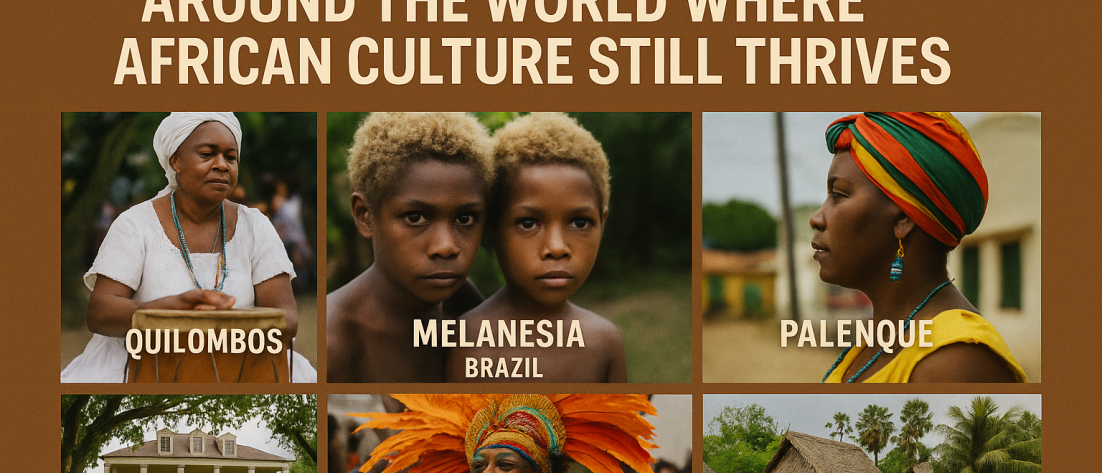
You don’t need a visa to see the places where Africa still breathes in full color, not just in bloodlines or borrowed phrases, but in how people dance, worship, cook, and show resistance. Around the world, far from the motherland, there are hidden afro villages where Black culture remains rooted in ancestral memory. From South America to the South Pacific, this listicle is your virtual trip into the unknown this weekend.
1. Brazil – Quilombos of Bahia
Tucked deep within the landscapes of Bahia, Brazil, exist entire communities founded by Africans who escaped slavery. Known as Quilombos, these villages still hold Yoruba names, shrines to Sango and Oshun, and traditional festivals like Festa de Iemanjá. The drums speak Yoruba, the food is seasoned with ancestral wisdom, and the spirit of resistance lives strong.
Must-see experience: Salvador’s Candomblé ceremonies and Iemanjá celebrations.
2. Colombia – San Basilio de Palenque
This town isn’t just African-influenced, it’s African-preserved. Founded by escaped African slaves in the 17th century, San Basilio de Palenque still speaks Palenquero, a Creole language with Bantu roots. Their hairstyles, songs, food, and spirituality are all linked to West and Central African traditions.
Must-see experience: The “Festival de Tambores” (Drum Festival) celebrating ancestral rhythms.
3. Papua New Guinea – Melanesian Islands
Here live some of the darkest-skinned people outside of Africa, many of whom have natural blonde hair. Though their ancestry is deeply African, centuries of isolation have created unique tribal cultures. The oral traditions, body art, and rituals mirror early African storytelling and spiritual systems.
Must-see experience: Fire dancing ceremonies and yam festivals that resemble West African harvest traditions.
4. French Caribbean – Guadeloupe & Martinique
These islands are more than sun and rum. They’re where French colonialism meets African soul. You’ll hear African rhythms in Zouk and see Yoruba deities hidden in Catholic saints. The cuisine, language, and carnival costumes shout resistance.
Must-see experience: Carnival in Martinique (a rebellious, rhythmic explosion of Creole-Afro pride).
5. Louisiana, USA – Creole Country
Forget Bourbon Street. The real magic is in the backstreets where Creole culture breathes: gumbo recipes passed down through generations, Voodoo rooted in Benin, and Zydeco music that sounds like African call-and-response. Louisiana is the beating heart of Black American spiritual resistance.
Must-see experience: A Voodoo tour through New Orleans and the Congo Square drum circles.
6. Suriname – Maroon Villages of the Rainforest
In the dense forests of Suriname, escaped Africans formed communities called Maroon villages. The Saramaka and Ndyuka people have preserved African spiritual systems, textile patterns, and oral histories. Here, children still hear ancestral tales by firelight in a language that blends African dialects with Dutch and English.
Must-see experience: Traditional storytelling nights and wood-carving ceremonies.
Why This Virtual Trip Matters
For too long, we’ve been taught that slavery was the end of African identity. The narrative has often centered around just a few countries, the U.S., the U.K., maybe Jamaica or Nigeria, as if these were the only places where Black people exist in large, thriving numbers. But this trip cracks that narrow lens wide open.
It shows us that Blackness is global, and African culture has taken root in places we rarely talk about. It challenges the popular belief that African identity was erased, instead, it was reimagined and re-rooted in new soil.
These virtual trips aren’t just cultural detours. They’re reminders that the African diaspora is more expansive, diverse, and enduring than we’ve ever been told. The more we uncover these hidden villages and their stories, the more we realize: Africa never left us. It followed us, hid in plain sight, and is still calling us home. These hidden villages prove otherwise. Africa didn’t die in the diaspora. It transformed. It traveled. It survived.
This isn’t just history. It’s evidence that our culture, no matter how far it’s scattered, always finds a way to re-root itself.
Did you know about these afro villages before now? Do you know about other afro villages? Let us know in the comments!


[…] cultural staples; jollof wars, soul food Sundays, carnivals, or the rhythm of Afrobeats. But to travel across the Black world, from the mountains of Jamaica to the streets of Salvador, Brazil, and the villages of Benin, is to […]