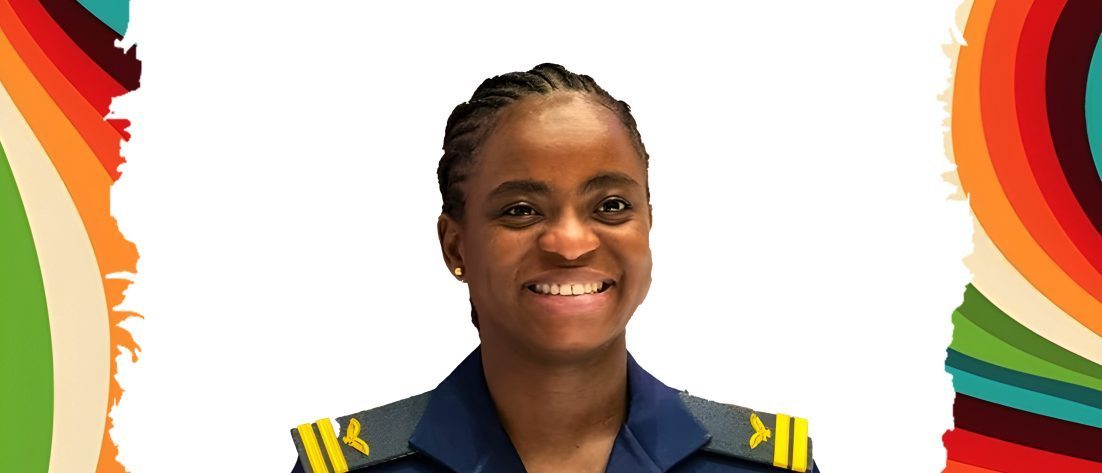
Over the last few years, Flight Lieutenant Kafayat Omolara Sanni’s career has quietly disrupted how Nigerians understand duty, capability, and who gets to be taken seriously in uniform.
When she became Nigeria’s first female fighter pilot in 2019, the headlines were quick to latch onto the “first” part. It made for easy inspiration. But if that’s all people noticed, they missed the point.
Kafayat didn’t enter the military to prove a cultural statement. She came to work.
Choosing a Different Kind of Path
For most young Nigerians, especially girls, career aspirations are rarely drawn from national defence or tactical aviation. There’s little visibility, little encouragement, and even less infrastructure for those paths to feel accessible. But Kafayat chose one of the most complex and technically demanding careers in the country and excelled.
She graduated as the best overall student from the Nigerian Air Force Academy in 2017. Two years later, she earned her fighter pilot wings after rigorous training in the U.S. and Nigeria. Her aircraft: the Alpha Jet and Super Mushshak, machines that require discipline, tactical precision, and mental sharpness under pressure.
There’s no shortcut to operating those jets. No headline can fake it.
Beyond Recognition: A Career Still in Motion
Since 2019, Kafayat has gone beyond her symbolic role. She has completed additional training in South Africa and Colombia, worked as a combat pilot, and now serves as an instructor, training future Nigerian Air Force pilots.
In June 2025, her name came up again, this time at the Ghana Armed Forces Command and Staff College, where she earned two of the institution’s most prestigious academic awards:
– Best Allied Student
– Best Assistant Commandant Paper
She wasn’t there for optics. She delivered value in rooms full of top military officers from across the continent. Her presence was earned, not handed over.
What Her Story Tells Us About Power and Process
It’s tempting to place women like Kafayat on a pedestal and stop there. But her career asks more of us. It asks what kind of systems we build that allow people to become excellent at their work regardless of gender, origin, or background.
Kafayat’s story is not just one of personal achievement. It’s also a case study in what happens when institutions are willing to evolve. The Nigerian Air Force trained her. It gave her a cockpit, not just a press release. That decision didn’t just open a door for her, it quietly challenged the blueprint.
This is the kind of shift that doesn’t happen by accident. It’s intentional, strategic, and long overdue.
A Mirror for the Bigger Picture
What stands out most about Kafayat’s journey is not that she’s the “first” at anything, it’s that she’s remained consistent in a role that demands performance, not personality. She doesn’t center herself in the story, but the work is there. And in a country where people often wait for validation to begin, her path reminds us that sometimes your skill is enough.
She is part of a generation of Nigerians who are not asking for change, they are doing the work that makes change inevitable.
Final Thoughts
Kafayat Omolara Sanni didn’t just break a barrier in 2019. She’s spent the years since showing that sustainability is just as important as disruption. She represents the kind of leadership that isn’t looking for the spotlight but ends up defining what it means to lead.
What have you learned from Kafayat’s journey? Tell us in the comments.