If you’re Black and you’ve ever traveled outside Africa, especially to a Western country, you might know the feeling.
You walk into a hotel, a restaurant, a store, any space at all, and something shifts. It could be a glance. A delay. A question that shouldn’t have been asked. You feel it before you even hear it. There’s that itch in your gut that says, “They don’t see me as a guest. They see me as a threat”.
Not every Black person may have experienced it firsthand, but far too many have. And for those who have, it’s hard to forget. This is stereotyping in motion. It’s in everyday experiences. It’s racism. It’s profiling. It’s the slow erosion of dignity for simply being Black.
And it just happened to two different Nigerians in very different ways.
Oyebanji Akins: Turned Away, Not Because of Who He Was But What He Looked Like
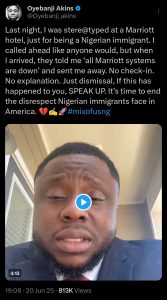
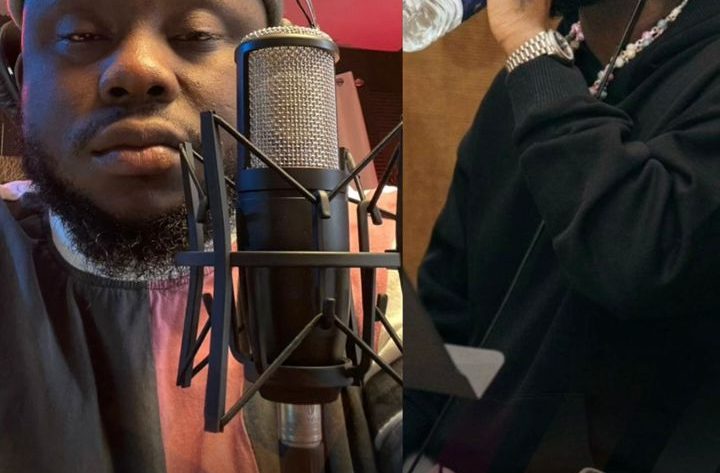
Oyebanji Akins, a popular critic and founder of CTDA Media, had just finished a studio session and was heading to check into a hotel he had booked in Houston, Marriott Bonvoy. The location wasn’t easy to find, so he called the front desk for help. When he did, he suspected that he was being stereotyped. On getting to the hotel, his suspicion was confirmed.
No one asked for his ID. No one checked his booking. They simply told him their system was down and that he should go find another hotel. No apology. No offer to assist. No humanity.
He ended up spending the night at a family friend’s place. The next morning, he called the hotel again and was told his booking had been cancelled. But when the rep found out that he is a Marriott Elite Ambassador, a title that shouldn’t have been necessary for basic respect, her tone shifted immediately. Suddenly, his room was available. Suddenly, he was welcome.
In Oyebanji’s words:
This wasn’t just about inconvenience, it was about how I was treated as a Nigerian.
He is currently in the process of taking legal actions.
If someone like Oyebanji can be dismissed so quickly, what chance do others have?
Davido in Ibiza: Even Global Stardom Couldn’t Outrun Racism

Not long after Akins’ story surfaced, another Nigerian, Afrobeats superstar Davido, shared his terrifying experience at a hotel in Ibiza, Spain. He wasn’t just profiled. He feared for his life.
While on holiday ahead of his manager’s wedding, Davido claimed that white security guards at a hotel in Ibiza physically threatened him and his team. In his words, they “tried to kill” him. His cousin, Tunji Adeleke, was manhandled and reportedly needed hospital attention.
Davido took to social media, saying:
All y’all going down.
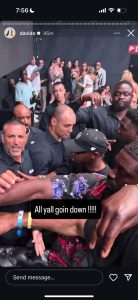
He promised legal action. And the emotion in his post was loud: frustration and fury at racial aggression.
Again, we’re forced to ask: What did we do wrong as Black people? Why is our presence seen as a threat?
This Isn’t Just Their Story, It’s All of Ours
What happened to Oyebanji and Davido is not isolated. It’s part of a long, painful pattern of how Black people are treated when they try to exist in spaces that weren’t built with them in mind.
– In 2018, Jermaine Massey was on the phone with his mother in the lobby of the DoubleTree Hotel in Portland when security approached him. He had a room. He had a key. But they said he was loitering and that he was a threat. He was escorted out.
– In 2022, comedian Mark Curry was stopped multiple times by hotel staff while sipping coffee in the lobby of the Wyndham Grand in Colorado. He showed his key. It wasn’t enough. He was asked to prove he was a guest. Again and again.
– Meek Mill, a global rapper, was denied entry into a Las Vegas hotel with no clear reason. Only after public backlash did the hotel apologize.
Different names. Different places. Same thread: Blackness seen as suspicious, and not deserving.
Stereotypes Are Not Random, They Are Designed
Stereotyping isn’t accidental. It’s not just a fluke of ignorance. It’s systemic. It’s wired into how Black people are perceived across the world, especially when they carry accents, African names, or cultural pride.
For Africans, especially Nigerians, there’s an added layer: the fraud narrative. It doesn’t matter whether you’re an artist, a doctor, or a business owner. Too many times, the first assumption is: scammer. Loud. Flashy. Aggressive.
And it’s this perception that gets people turned away, watched, or made to feel like outsiders in rooms they’ve paid to be in.
Numbers Don’t Lie, But They Do Hurt
– A 2023 report by MMGY Global found that 71% of Black travelers in the U.S. felt they had been treated differently at hotels and travel destinations because of their race.
– The Black Travel Alliance reports that while Black travelers contribute over $109 billion to the U.S. travel economy, the industry rarely reflects or protects them.
Black consumers globally spend billions annually on travel, but hospitality spaces still operate on assumptions rather than service.
We bring money. We bring culture. We bring value. But still, we are made to feel like guests in a house we helped build.
It’s More Than Bad Service. It’s Dehumanization
Let’s be clear: this isn’t about poor customer service. This is about being ignored until your status demands attention. This is about not being seen until you prove your worth. It’s the emotional labor of having to over-explain, over-perform, and overcompensate just to be treated fairly.
When Oyebanji had to mention his ambassador status for the hotel to acknowledge him, it wasn’t a flex. It was a case of being ignored until his status demanded attention. When Davido had to go public for people to believe him, it wasn’t drama. It was anger at racial aggression.
The sad part is that for millions of Black people who don’t have that title or fame, there is no second chance to be recognized.
So, What Now? Where Do We Go From Here?
We talk. We post. We share. But real change starts with acknowledgment. The hospitality industry, and many others, need to start asking:
– Why do we default to suspicion when we see Black guests?
– What biases have we normalized under the guise of “policy”?
– Who are we protecting, and who are we pushing out?
This is not just a wake-up call. It’s a call to order. Because while brands post Black boxes in solidarity, Black bodies are being boxed out of spaces they belong in.
We need more than statements. We need systems that protect people, all people.
Black People Deserve to Fair Treatment
We deserve to enter any space without shrinking.
We deserve rooms without suspicion.
We deserve rest without negotiation.
Stereotyping isn’t just unfair. It’s dangerous. It’s disrespectful. It reduces people to fears and assumptions. It strips them of agency and humanity.
Oyebanji’s story was quiet, until status forced recognition. Davido’s story was loud, because he made sure the world heard it. But don’t forget the thousands of quiet stories happening every day, to people who don’t have followers, lawyers, or fans.
Let these stories not just be read. Let them be felt. Let them be shared. Let them lead to conversations that don’t end in hashtags, but in new habits.
Because Black travelers, Black guests, Black people, we belong too.
And we’re done being treated with scorn and disrespect.
We Want to Hear Your Voice
Have you ever been stereotyped or racially profiled while traveling or simply existing in a space?
Share your story in the comments. Your experience matters, and it could be the wake-up call someone needs.