In the early 1900s, Black women were seen but rarely heard.
And certainly not behind the wheel.
To be a Black woman in America at the turn of the 20th century was to live under a double bind, one of race and one of gender. The laws might not have spelled it out word for word, but society made it plain: Black women were expected to remain invisible. Quiet laborers. Domestic workers. Mothers. Servants. Anything else was met with resistance or ridicule.
They couldn’t vote.
They couldn’t own property freely in many places.
They were rarely educated beyond the basics, and even less likely to be employers or entrepreneurs.
White women, too, were confined by social norms: expected to occupy the home, tend to children, and rely on male guardians for mobility. But the restrictions were tighter for Black women, whose labor was expected without reward and whose ambitions were treated with suspicion.
So when the automobile emerged, noisy, clunky, but luxurious, it became more than a machine. It became a boundary line. Mobility, both literal and social, belonged to white men. The car became a symbol of status, wealth, and power.
Women weren’t expected to own cars.
Black women weren’t even expected to aspire to such a thing.
But Then Came a Woman Named Sarah Breedlove
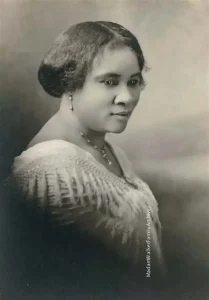
Born in 1867 in Delta, Louisiana, the first in her family born free after slavery, Sarah’s life began with loss. Her parents died before she turned 8. She married young to escape abuse from relatives. Widowed by 20. A single mother. Washerwoman. Living on $1.50 a week.
She had little formal education, but she had something most others didn’t: proximity to Black women’s needs. Working with her hands, she noticed how many women around her, including herself, were losing their hair. Poor sanitation, stress, and limited access to quality hair care had taken a toll.
That need sparked a business.
She began experimenting with scalp treatments and homemade formulas. In time, she created what became known as the “Madam Walker’s Wonderful Hair Grower”, a blend of petroleum jelly and sulfur that helped stimulate hair growth. It worked. And word spread.
By 1905, she had moved to Denver. She married Charles Joseph Walker, a newspaper man, and adopted the name Madam C.J. Walker, not just as a wife, but as a brand.
Her business wasn’t just selling hair products. It was creating opportunity. She trained Black women to become “Walker Agents,” offering employment, dignity, and economic power. By 1910, she opened a factory in Indianapolis, and by the mid-1910s, she was reportedly earning over $10,000 a year, a considerable sum at the time.
With that wealth came something most Black women, and many men, had never owned: an automobile.
The Car Wasn’t the Goal, It Was the Signal
Owning a car in 1910 America was uncommon. For a woman, even more so. For a Black woman? Almost unheard of.
Madam C.J. Walker didn’t buy a car to show off. She bought it because she could, and because it served her work. She needed to travel. Visit distributors. Attend conferences. Speak to rooms full of Black women about money, independence, and dignity.
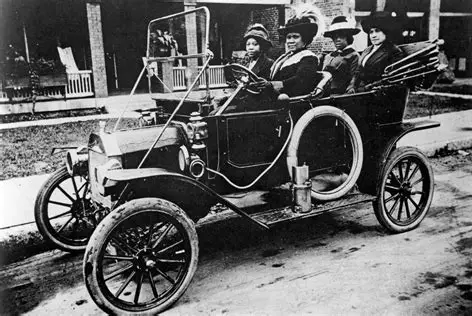
Photos from the time show her behind the wheel of her Ford, a powerful image. A Black woman driving herself. In broad daylight. Not being driven. Not waiting. Not backgrounded.
Her car allowed her to move, in every sense. And it forced people to see her.
Not Just a Car, A Practical Power Move
There’s a temptation to romanticize moments like this, to turn them into dramatic breakthroughs. But what Madam Walker did was practical, intentional, and rooted in reality.
She built a business that responded to a need.
She used the profits to fund expansion, independence, and philanthropy.
And she used the car, not as a symbol, but as a tool.
By the time she died in 1919, she was one of the wealthiest self-made women in America, Black or white. She had employed thousands. Donated to civil rights causes. Built a mansion in New York’s Hudson Valley, designed by Black architect Vertner Tandy, that rivaled the homes of the white elite.
And yes, she drove.
So, Who Was the First Black Woman to Own and Drive a Car?
It was Madam C.J. Walker, as far as history records.
Not because she sought to break barriers, but because she built something big enough to need a car.
And when she got behind the wheel, she didn’t just move herself, she helped move others forward.
Madam C.J. Walker moved herself when the world didn’t expect her to. What’s one area in your life you’re reclaiming control over? Leave your reply in the comment box.