On the night of September 30th, 1960, the Union Jack, which was the British flag we had lived under for decades due to colonialism, was lowered. In its place, for the first time, the Green-White-Green was lifted into the air. That moment signified Nigeria finally breathing with her own lungs, speaking with her own voice, and standing on her own feet.
But the story of that flag, and the man who gave it to us, is not as widely told as it should be.
A 23-Year-Old Dreamer in London
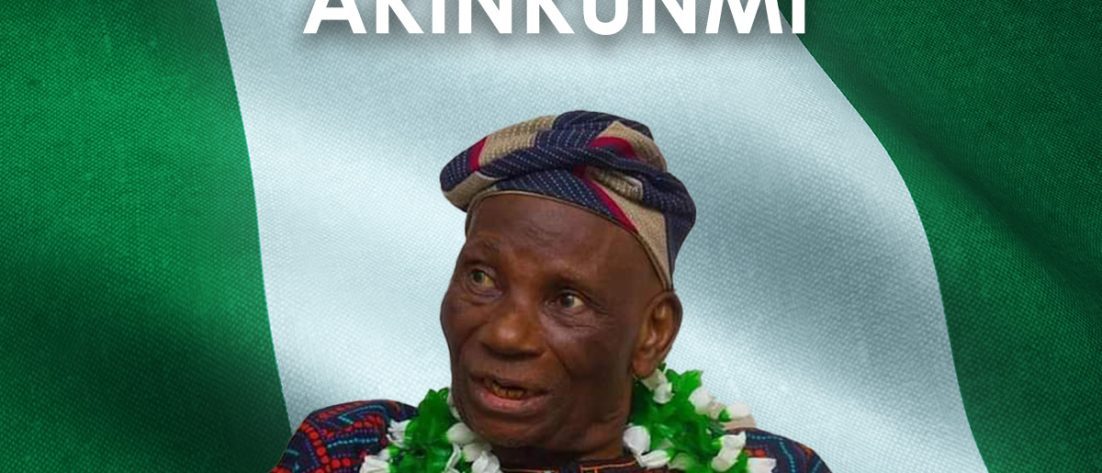
Back in 1959, one year before independence, a young Nigerian student named Michael Taiwo Akinkunmi was in London, studying electrical engineering. He was just 23, far from home, but his heart was restless for the Nigeria that was about to be born.
One day in a library, he stumbled on an announcement: the colonial government was holding a competition to design a new flag for Nigeria.
Akinkunmi sat down and sketched three vertical stripes: green, white, green. To him, the green stood for the land, the soil, the endless richness of Nigerian agriculture. The white was the peace and unity we really needed as a people with many tongues and traditions. In the middle, he drew a red sun with shining rays, a symbol of divine guidance for the new nation.
He sent his entry off to Lagos and went back to his books.
Months later, a letter came: his design had been chosen, beating almost 3,000 other entries. He was given a prize of £100 which was good money back then but nowhere near the worth of what he had given the country.
The Simplicity That Spoke Volumes
When the selection committee reviewed his design, they made one big change: they removed the red sun. The reason was simple, Nigeria was too diverse for any one religious or spiritual symbol. The Green-White-Green alone was powerful enough.
So that was how the flag we know today was born; minimal, bold, and ready to speak for a people carving their path.
On October 1st, 1960, as fireworks lit the sky, Akinkunmi’s flag was raised for the first time. A 23-year-old student in London had just given Nigeria her face.
The Hero Without Honour
You would think that a man who designed the nation’s identity would live a celebrated life, his name written in gold.
After independence, Akinkunmi returned home and quietly took a job in the civil service, working in the Ministry of Agriculture in Ibadan. For decades, he lived an ordinary life, serving the country in obscurity. Many people didn’t even know the face behind the flag.
He became what many called a “hero without honor.” The flag flew high in stadiums, schools, international meetings but its maker lived quietly, almost forgotten.
It wasn’t until 2006 that a university student, Sunday Olawale Olaniran, while digging through Nigerian history, went to find him. He met Pa Akinkunmi, already elderly, living simply in Ibadan, looked after by neighbors. Yet, even in that quiet life, he never complained. He would still pray for Nigeria, still bless the land he had given a symbol of unity.
Late Recognition
It took almost 50 years for Nigeria to finally recognize him properly and only because of public pressure from the protest by Sunday to recognise him. In 2014, President Goodluck Jonathan awarded him one of the country’s highest honors, the Officer of the Order of the Federal Republic (OFR).
By then, he was already old, but people started calling him “Mr. Flag Man.” In 2021, at 85, he even unveiled the world’s largest Nigerian flag in Ibadan, a full-circle moment for a man who had once sketched three stripes in a London library.
A Painful Goodbye
Michael Taiwo Akinkunmi passed away in August 2023 at the age of 87. You would think the man who designed our flag would have been given a swift, dignified state burial. Instead, his body remained in the morgue for over a year due to government bureaucracy. It was Oyo State, not the federal government, that eventually stepped in to ensure he was buried with dignity.
Even in death, he carried the same story: honored in name, but underserved in practice.
What The Flag Says About Us
Today, every time you see the Green-White-Green, you’re looking at more than fabric. You’re looking at the dream of a 23-year-old boy who believed Nigeria could stand tall. You’re looking at agriculture, at unity, at peace. You’re looking at our pride, our promise, and yes, our contradictions.
Because the flag unites us, but the story of its creator reminds us how easily we forget our builders.
So, on this Independence Day, when you wave that flag or pin it to your chest, think of the young man who dreamed it into being. Think of the life he lived in the shadows. Think of how Nigeria still struggles to honor her true heroes.
The Green-White-Green is not just our identity. It’s a mirror. And in it, we see both the beauty of what we are, and the work we still have to do.
Happy Independence Day, Nigeria. May we fly higher than the cloth, and finally give flowers to the hands that planted them.