“Nigeria is a lawless country. Until we have laws that protect people, nobody will invest in Nigeria.”
— Peter Obi, former presidential candidate, on X, June 24, 2025
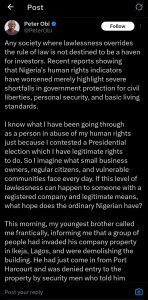
When Peter Obi, former presidential candidate and respected businessman, shared a distressing account on X on June 24, 2025, of how his younger brother’s property was unlawfully demolished in Lagos, it exposed a pattern of systemic disregard for the rule of law. But beneath the rubble of that building lies a much bigger tragedy: the erosion of the rule of law in Nigeria and its dangerous consequences for the country’s economic future.
This isn’t just about one individual’s loss. It’s a national emergency.
And its cost is measured in billions.
The Silent Killer of Growth: Why Law Matters to Investors
Investors, both local and foreign, don’t just seek profit.
They seek stability, predictability, and protection.
No business wants to operate in a system where:
– Property can be seized or demolished overnight
– Contracts can be violated with no consequences
– Police and government agencies act without accountability
– Court judgments can target “unknown persons” and still be enforced
– Justice is slow, corrupt, or completely absent
When the laws of a country no longer protect its people or its businesses, the message to investors is clear: Your capital is not safe here.
Why the Rule of Law is the Bedrock of Economic Development
The World Bank’s 2020 “Doing Business” Report (the final edition before the index was discontinued) ranked Nigeria 131st out of 190 countries. One of the lowest scores?
– Enforcing Contracts
– Registering Property
– Dealing with Construction Permits
These indicators are crucial. They determine how easy or hard it is for a business to:
– Acquire land or property
– Sign legally binding contracts
– Get justice when agreements are breached
In short, rule of law is not just a governance issue, it’s an economic engine.
The Steady Decline of Investor Confidence
Despite being Africa’s largest economy by GDP and population, Nigeria has seen a steep drop in Foreign Direct Investment (FDI).
According to the National Bureau of Statistics (NBS):
FDI inflows dropped from $2.3 billion in 2014 to just $377 million in 2023.
That’s an over 80% decline in under a decade.
In 2022, Ghana, with just 16% of Nigeria’s population, received more startup funding per capita than Nigeria.
These figures underscore a reality that can no longer be ignored:
Investors are not fleeing the market, they’re fleeing the system.
Peter Obi’s Story is a Mirror of a Larger Breakdown
In his account shared on X on June 24, 2025, Peter Obi described rushing from Abuja to Lagos after learning that his brother’s company property in Ikeja was being demolished without any valid demolition order or court judgment served on them.
– The demolition was based on a court judgment issued against “unknown persons”.
– No demolition permit was presented.
– The contractor and excavator operators refused to name who sent them.
– No law enforcement official could provide documentation or justification.
If a man of Peter Obi’s influence can be treated this way, what happens to the everyday Nigerian business owner?
A Pattern of Demolitions Without Due Process
Sadly, the Ikeja demolition isn’t an isolated event. Across Nigeria, there’s a disturbing trend of demolitions carried out without proper legal backing or sensitivity.
Just days before Peter Obi’s revelation, another controversy erupted in Owo, Ondo State. On June 21, 2025, Governor Lucky Aiyedatiwa ordered the demolition of the monument built in memory of the Owo Catholic Church massacre victims, a massacre that horrified the nation on June 5, 2022.
That monument, constructed under the administration of the late Governor Oluwarotimi Akeredolu, was intended as a solemn tribute to innocent worshippers killed in a house of God. The demolition, reportedly to make space for a “world-class shopping complex,” was widely condemned for its insensitivity, moral bankruptcy, and disregard for collective memory.
These cases reveal a broader problem: those in power acting without restraint, undermining justice and social conscience in the name of development or control.
From Lawless Streets to Shattered Shops: The Domino Effect
Lawlessness doesn’t just affect political elites, it destroys small and medium-sized businesses, which make up over 80% of Nigeria’s employment base, according to SMEDAN.
Effects of a lawless environment on business:
– Loss of assets: Demolitions, land grabbing, and seizures with no compensation
– Fear of scaling: Entrepreneurs refuse to grow for fear of being noticed by extortionists or power-hungry agents
– Capital flight: Investors move their money abroad to safer environments
– Brain drain: Young Nigerians see no future in a broken system
In Obi’s words:
“If this level of lawlessness can happen to someone with a registered company and legitimate means, what hope does the ordinary Nigerian have?”
What Other African Nations Are Getting Right
African neighbors like Rwanda, Ghana, and Senegal have become beacons of business stability, not because they have more resources, but because they have better systems.
Rwanda moved from post-genocide chaos to one of Africa’s best destinations for business in under 20 years, thanks to zero-tolerance policies on corruption and strong legal reforms.
Ghana is attracting fintech and agritech investment because its courts work, and investors are protected.
Senegal’s stable democracy has positioned it as a rising West African star.
What’s their secret? Law. Order. Trust.
What Must Change: Rebuilding Nigeria from the Constitution Up
We cannot keep patching broken institutions. Nigeria must:
– Digitize and publicly register all court judgments
– Reform the judiciary to ensure speed, accessibility, and transparency
– Criminalize illegal demolitions and seizures
– Protect property rights as sacrosanct
– Guarantee contract enforcement without interference
– Give the Nigerian people confidence in due process
Economic development is impossible without legal confidence.
Nigeria Must Choose: Lawlessness or Progress
What happened to Peter Obi’s brother, and what is happening in places like Owo, is not random. It’s systemic.
The disease is lawlessness.
And the consequence is economic stagnation.
Until we address this disease, no policy, no loan, and no investor will save us.
Let’s Talk
Have you witnessed illegal demolitions or violations of property rights in Nigeria?
Do you think Peter Obi’s call for a lawful Nigeria is achievable?
What will it take for Nigeria to become truly investor-ready?
Share this article. Join the conversation. Demand accountability.
A lawful Nigeria is not a dream, it’s a decision.
P.S.
Peter Obi said “A new Nigeria is POssible.”
Was that just a hopeful pun on Peter Obi’s initials, P.O., or was it a roadmap from someone who truly has a plan to build a lawful, secure, and investable Nigeria?