Wait, Did You Just Say Egusi Went to Space?
Yes. The same egusi you blend for soup. Only this time, it wasn’t heading for a pot of soup, it was going to the International Space Station (ISS).
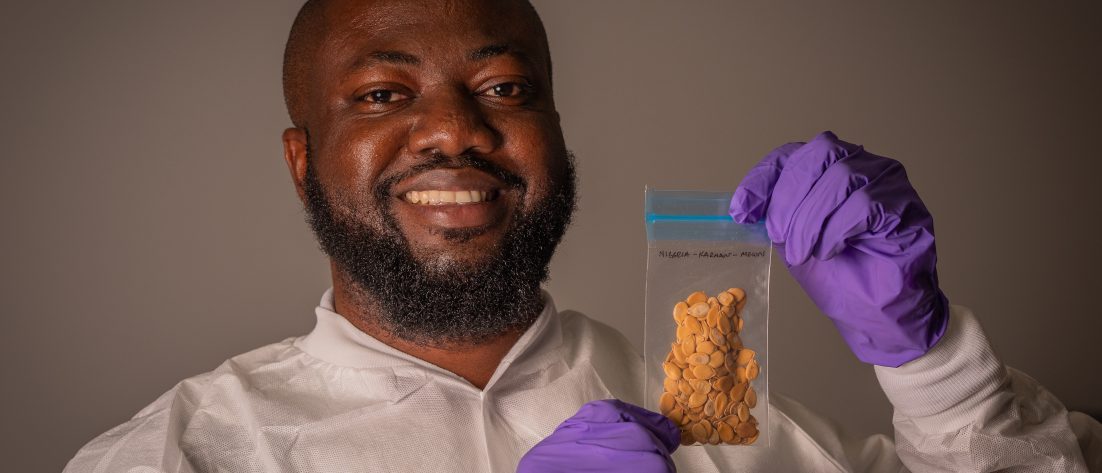
In a first-of-its-kind mission, Nigeria sent egusi melon seeds to space as part of a global research initiative on how crops respond to microgravity. Leading this project is Dr. Temidayo Oniosun, a 30-something Nigerian space policy expert and founder of Space in Africa, an organization that tracks Africa’s growing space ecosystem.
But before you wonder why anyone would send soup ingredients into orbit, let’s break it down because what Dr. Oniosun has done is bigger than food. It’s about identity, science, and rewriting Africa’s place in the future of humanity.
How Did We Get Here? A Nigerian in the Global Space Scene
Raised in Oyo State, Nigeria, Dr. Temidayo Oniosun studied meteorology at FUTA before moving on to advanced space policy programs in Europe and the U.S.
Instead of becoming an astronaut, he took a different route, working to shape policy and strategy for how Africa can enter the space race meaningfully.
He founded Space in Africa to provide data, research, and strategy around Africa’s involvement in space, essentially making sure the continent isn’t left behind. Today, he’s a respected name in international space policy circles, advising governments and agencies.
But Why Egusi?
This is the big question and the genius of it all.
When asked why egusi was chosen, Dr. Oniosun explained:
“We considered different options and selected egusi, which is culturally significant and widely consumed in Nigeria.”
— The Guardian Nigeria
The idea wasn’t simply to put Nigerian food in orbit for pride or fun, but rather to contribute to a growing field of astro-agriculture, the study of how crops grow and adapt in space. Dr. Oniosun continued:
“The egusi seed was sent into space aboard the SpaceX Crew-11 mission to participate in a global scientific experiment exploring how different seeds respond to the space environment.”
— Guardian Nigeria
Egusi is more than food. It’s a shared cultural symbol in Nigerian households, used in stews from Lagos to Ilorin. It represents home, tradition, and identity. But Dr. Oniosun wasn’t trying to prove cultural pride. He saw egusi as the perfect candidate for something deeper: an opportunity to explore how crops native to Africa might behave in space.
He’s right. Egusi is protein-rich, heat-resistant, and drought-tolerant. If we’re ever going to grow food in space, or on Mars, wouldn’t it make sense to test crops that already thrive in extreme conditions?
What Exactly Happened?
On July 31, 2025, egusi melon seeds, a beloved staple in Nigerian cooking, were launched into space aboard a SpaceX Falcon 9 rocket as part of NASA’s Crew-11 mission to the International Space Station (ISS). The seeds were part of an international scientific experiment to study how food crops from different regions respond to the unique conditions of space.
Once aboard the ISS, the seeds were exposed to microgravity and space radiation for several days. They’ll return to Earth where scientists in Ibadan and Florida will analyze how the space environment altered their structure, genes, and growth potential.
The Journey from Oyo to Orbit
The seeds used in the experiment were sourced from Oyo State, Nigeria. Before launch, they were processed to meet the stringent safety and sterilization protocols of NASA. The mission was part of a broader effort coordinated by Jaguar Space and The Karman Project, which invited representatives from emerging space nations to select a seed of cultural or scientific relevance for experimentation aboard the ISS.
“I argued for egusi, and after a thorough evaluation, Jaguar Space took the lead on mission integration, ensuring the seeds met the ISS safety and packaging standards.”
— Guardian Nigeria
What Will Happen to the Seeds?
The seeds spent a few days in microgravity aboard the ISS before returning to Earth. Post-mission analysis will be conducted at the University of Florida and the International Institute of Tropical Agriculture (IITA), Ibadan.
“Scientists will test for changes in germination, gene expression, metabolic activity, and viability compared to control samples on Earth.”
— Guardian Nigeria
To clarify public concerns, Dr. Oniosun emphasized:
“This has nothing to do with GMO.”
— Guardian Nigeria
The results could shape future agricultural experiments and possibly influence what food astronauts eat on long-duration missions. Imagine Nigerian egusi soup on a mission to Mars.
A First for Nigeria and West Africa
This is the first time a West African agricultural product has entered space as part of a scientific research program. It marks a major step forward for African representation in space-based research, beyond satellites and space tech.
“This is the first time any agricultural product from West Africa has entered orbit.”
— Guardian Nigeria
The symbolism of the mission also resonated widely:
“If egusi can reach space, so can young Nigerians.”
— Guardian Nigeria
This is more than a quirky headline. It’s a landmark moment for African science and how we tell our stories.
For decades, Africa has been the “subject” of research, not the driver. What Dr. Oniosun has done flips that script. He put Nigeria’s cultural food on the global research stage, using it to ask new scientific questions that matter not just to Africans, but to the world.
What’s Next?
This mission is just the beginning. Dr. Oniosun is already in talks with other African scientists to send more indigenous crops to space, create regional data labs, and establish a pipeline of African-led space experiments.
He’s also launching a campaign to let the public vote on what the next seed to space should be.
His long-term goal? To ensure African innovation isn’t just about catching up but leading from the front, especially in fields like astro-agriculture, where no continent has an unfair head start.
What African crop do you think should be sent to space next? Drop your suggestion in the comments!
ALSO READ: Oyebanji Akins Becomes First Nigerian Music Critic Inducted into the Grammy Recording Academy